
Ginkgo biloba biloba: real effects and limitations
You've been noticing for weeks that your memory isn't what it used to be. You struggle to remember names, lose track in conversations and feel like your brain is running slower than normal. You've heard about ginkgo biloba as the natural solution for these problems, but you don't know if it really works or is just another miracle product.
It's understandable that you have doubts. Ginkgo biloba is one of the world's best-selling supplements for memory and cognitive performance, but also one of the most controversial. Between contradictory studies and exaggerated promises, it's hard to know what to really expect from this ancient extract.
The reality is that ginkgo biloba can help, but probably not in the way you imagine. And certainly not with the effectiveness you need if you're looking for real and lasting results.
In summary: Ginkgo biloba improves cerebral circulation and has moderate neuroprotective effects, but its efficacy as monotherapy is limited. Studies show modest benefits in memory and concentration, especially in older adults with mild cognitive impairment.
The cause and solution: Cognitive decline arises from multiple factors: poor circulation, oxidative stress, inflammation and neurotransmitter deficits. Ginkgo only addresses one of these problems. Synergistic formulas that combine several mechanisms of action obtain superior results.
The usual solution: what science says
Ginkgo biloba works primarily through two mechanisms. First, it improves cerebral microcirculation by inhibiting platelet activating factor (PAF), which reduces platelet aggregation and increases blood flow to the brain. Second, it acts as a potent antioxidant, protecting neurons from damage caused by free radicals.
Clinical studies show mixed but promising results. Weinmann et al., 2010 found that doses of 240 mg daily of standardized extract EGb 761 significantly improved working memory and processing speed in healthy adults after 6 weeks of treatment.
For age-related cognitive decline, results are more consistent. Ginkgo biloba extract has been shown to improve global cognitive function, especially in episodic memory and sustained attention tasks. The responsible active compounds are flavonoid glucosides (24%) and terpene lactones (6%), which work synergistically to protect and nourish brain tissue.
The problem with ginkgo biloba alone
Here's the problem: ginkgo biloba addresses only part of the cognitive equation. While it improves circulation and reduces oxidative stress, it does nothing to optimize neurotransmitter synthesis, improve neuronal membrane integrity or enhance mitochondrial energy production.
Meta-analyses reveal that ginkgo's effects as monotherapy are statistically significant but clinically modest. Tan et al., 2015 analyzed 21 randomized studies and concluded that, although ginkgo improves some aspects of cognitive function, effect sizes are small to moderate.
Additionally, ginkgo biloba has significant limitations. Its absorption varies between individuals, it can interact with anticoagulants and its effects take 6-8 weeks to fully manifest. For many people seeking immediate and substantial cognitive improvements, these limitations are frustrating.
The reality is that the brain is a complex system that requires multiple types of simultaneous nutritional support. Betting everything on ginkgo biloba is like trying to fix a car by checking only the engine: it may help, but it won't solve all the problems.
What really works
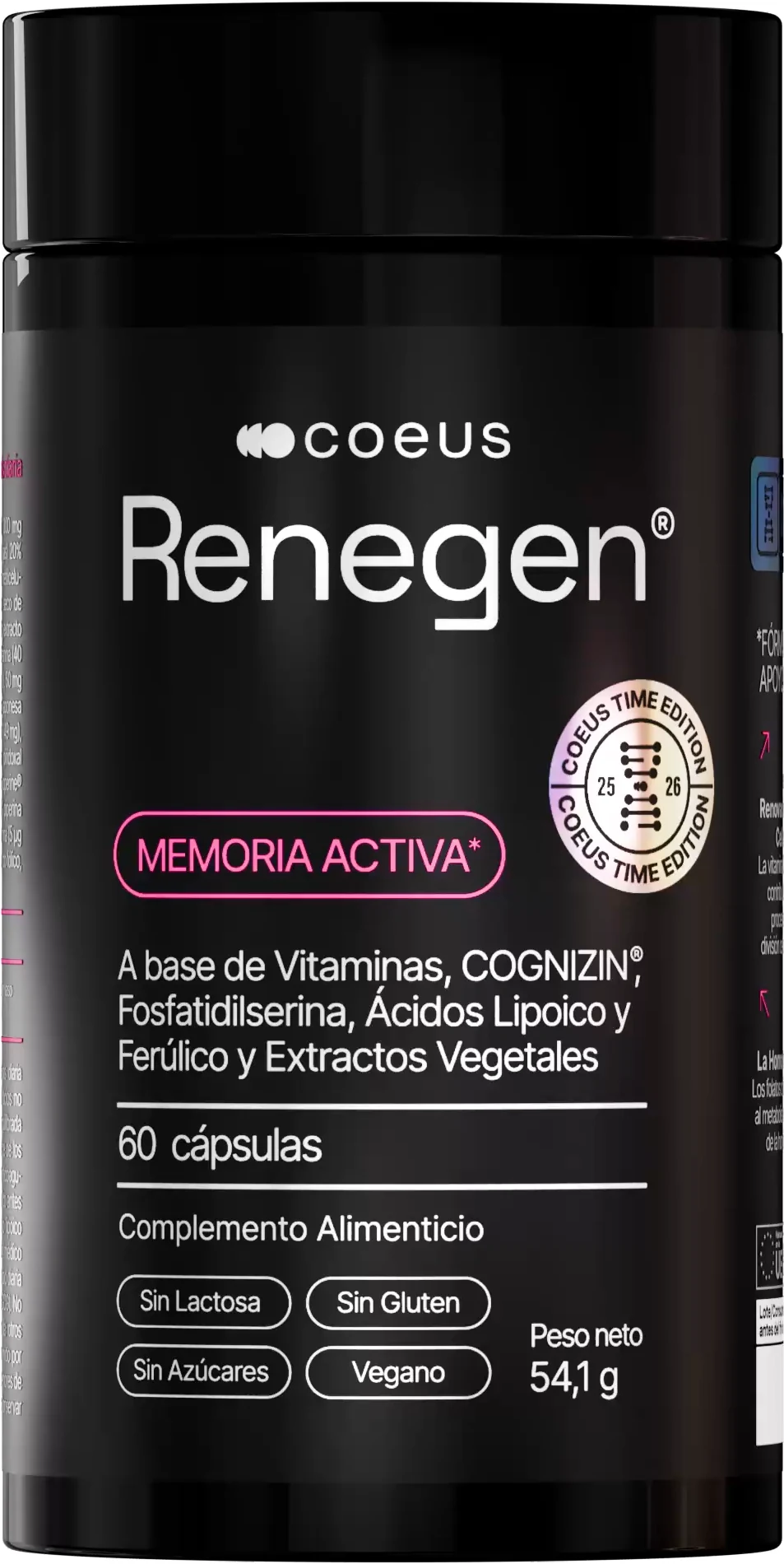
Modern research points toward synergistic formulas that attack cognitive performance from multiple angles. That's why we developed Renegen®, which includes ginkgo biloba as part of a complete cognitive matrix, not as a lone protagonist.
Renegen® combines ginkgo biloba with COGNIZIN® (patented form of CDP-choline), which directly increases brain acetylcholine levels to improve memory and focus. Phosphatidylserine optimizes neuronal membrane fluidity, while Bacopa monnieri enhances neurogenesis and formation of new synaptic connections.
This multitarget approach is what makes the difference. While ginkgo biloba improves cerebral blood flow, COGNIZIN® ensures that your neurons have enough fuel (choline) to produce acetylcholine. Phosphatidylserine keeps cell membranes flexible for efficient neuronal communication, and Bacopa monnieri protects these improvements long-term.
Users report notable effects in the first 1-2 weeks: greater mental clarity, less cognitive fatigue and better information retention. It's not magic, it's science applied correctly.
Discover Renegen® and experience the difference →
Scientific references
- Weinmann S, Roll S, Schwarzbach C, Vauth C, Willich SN. Effects of Ginkgo biloba in dementia: systematic review and meta-analysis. BMC Geriatr. 2010
- Tan MS, Yu JT, Tan CC, Wang HF, Meng XF, Wang C, Jiang T, Zhu XC, Tan L. Efficacy and adverse effects of ginkgo biloba for cognitive impairment and dementia: a systematic review and meta-analysis. J Alzheimers Dis. 2015
Time is yours.
Time is yours. Take it.
There is no perfect moment to start, only the decision to do it. Start the change today towards a life with more years... and years with more life.
Start your change now